English




172K Jobs: Why a Fed Rate Hike Is Back on the Table

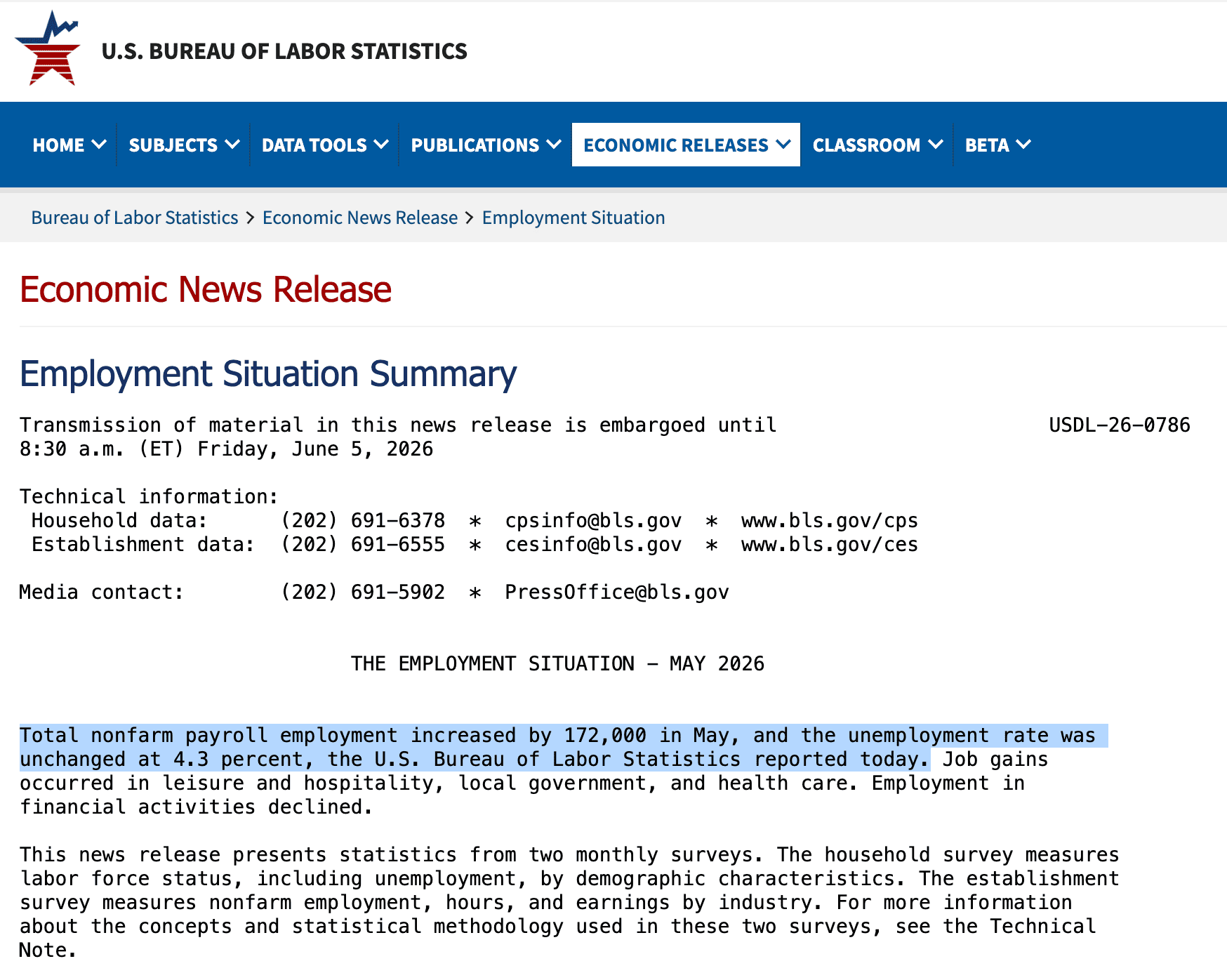
U.S. employers added 172,000 jobs in May 2026 — more than double the ~80–85K consensus — while unemployment held at 4.3% and March–April were revised up by a combined 93,000. The third straight blowout report flipped the bond market: CME FedWatch now puts the odds of at least one Fed rate hike in 2026 above 57%, higher than the combined odds of a hold or a cut. The "rate cut is coming" consensus that ran 2026 just died on contact with the data.
For six months the sell-side script had one ending: hiring rolls over, the Fed blinks, cuts arrive by autumn. May's jobs report didn't miss that script — it set it on fire. A Fed rate hike, the trade nobody on the cut-obsessed desk wanted to name, is now the bond market's base case for what's mispriced.
Why is the market suddenly pricing a Fed rate hike, not a cut?
Because traders stopped listening to the narrative and started reading the tape. Within minutes of the print, FedWatch odds of at least one hike this year jumped from roughly 50% to around 57–58%, overtaking the combined probability of a hold or a cut. The 10-year Treasury yield spiked to 4.54%; the rate-sensitive 2-year jumped about 10 basis points into the 4.1% area. Equities sold off into the strength — the textbook "good news is bad news" reaction.
Read it plainly: the directional risk the market cares about has inverted. The question is no longer how many cuts — it's whether the next move is up. That's a regime change in positioning, not a wobble.
How big was the May jobs beat, actually?
Big enough to embarrass the forecasters. Headline payrolls printed 172,000 against a consensus near 80–85K — a beat of more than 2x. Unemployment held at 4.3% for a third straight month. Average hourly earnings rose 0.3% on the month and 3.4% year over year (around $37.53).
The internals back the headline: leisure and hospitality added ~70K, local government ~55K, health care ~35K, and even manufacturing eked out ~7K. Financial activities was the notable loser, shedding jobs. This wasn't one freak sector carrying the number — it was broad services demand that refuses to quit.
Do the revisions change the story? (They are the story.)
This is where the cut case quietly collapses. March was revised up to 214,000 and April to 179,000 — a combined 93,000 more jobs than previously reported, and the strongest three-month stretch in over two years.
Here's the uncomfortable part for the doves: the "labor market is cracking" thesis was built on soft prints that just got revised away. The evidence base for cuts didn't weaken — it was a measurement artifact, and the artifact is gone. You cannot run a rate-cut argument on data that no longer exists.
Why did stocks fall on a strong jobs report?
Mechanics, not mood. Stronger growth alongside sticky inflation pushes the expected path of policy higher; higher yields lift the discount rate on future earnings, compressing valuation multiples — and the longest-duration, rate-sensitive growth names take the hardest hit. So S&P and Nasdaq futures slid even as the economy looked healthier. Bonds set the tone; equities followed.
Note what is not driving this: wages. At 3.4% YoY, earnings growth is the slowest since 2021 and still trails inflation. The hike pressure isn't a wage-spiral story — it's resilient demand colliding with inflation the Fed hasn't finished killing.
What happens at the June 17 Fed meeting?
The next decision lands June 17 — Kevin Warsh's first meeting as chair, with the White House loudly lobbying for cuts. That sets up a direct collision: the data argues for hawkish patience, the politics argue for easing. Markets aren't pricing an actual move on the 17th; the real fight is over the back half of the year.
Expect the framing, not the action, to move markets. If Warsh signals that inflation — not the labor market — is now the binding constraint, the front end reprices further. As one strategist framed it, pushing for cuts here would mean pushing against the evidence. Whether the Fed actually delivers a hike remains an open question — but it's no longer a tail it can wave away.
Is the 2026 rate-cut thesis dead?
On this data, yes — and arguing otherwise is fighting the print. Three consecutive consensus-beating reports, upward revisions, a steady 4.3% unemployment rate, and wage growth that's cooling without collapsing add up to an economy that does not need rescuing. The cut case now requires a deterioration that simply isn't in the numbers.
That's the interpretive call, stated without a hedge. The empirical call — will the Fed hike, and when — is genuinely open, and anyone selling you October-vs-December certainty is guessing. But the burden of proof has switched sides. For the first time this cycle, the people who have to explain themselves are the ones still waiting on cuts.
Bottom line
The May jobs report didn't just beat expectations; it dismantled the premise of the entire 2026 rate-cut trade. With revisions confirming the strongest hiring run in two years, the market has done the honest thing and started pricing a Fed rate hike. The consensus had the direction wrong — and the bond market just said so out loud.
FAQ
What were the May 2026 nonfarm payrolls? 172,000 jobs added, versus a consensus near 80–85K.
What is the U.S. unemployment rate now? 4.3%, unchanged for a third straight month.
What are the odds of a Fed rate hike in 2026? Around 57–58% for at least one hike by year-end, per CME FedWatch — above the combined odds of a hold or a cut.
When is the next Fed meeting? June 17, 2026 — Chair Kevin Warsh's first.




Bonus rebate to help investors grow in the trading world!