English




Honeywell Reaffirms 2026 Outlook Before Aerospace Spinoff — and the Market Is Missing the Point

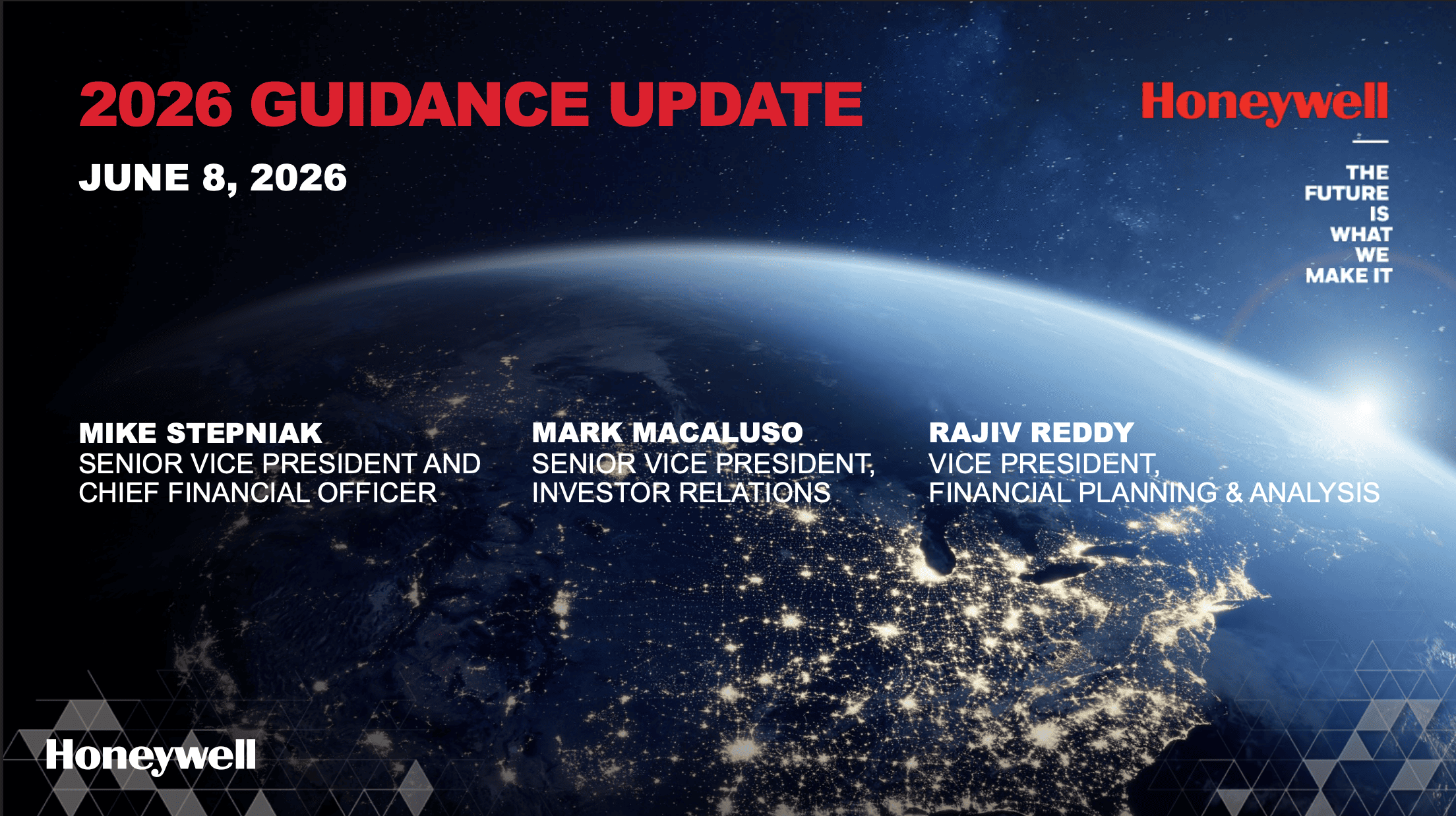
Honeywell reaffirmed its full-year 2026 guidance on June 8, with its aerospace business still on the books ahead of the pending spinoff. Shares ticked up modestly in premarket trading. The market's shrug is a misread — a guidance hold under structural transformation is a statement of confidence, not a holding pattern.
Does Honeywell Reaffirming Guidance Before a Spinoff Actually Matter?
Yes — and the market's lukewarm premarket reaction proves most people are reading this wrong.
Guidance reaffirmations are typically treated as non-events. The tape moves, analysts nod, and the news cycle rolls on. But reaffirming a full-year outlook when your largest business segment is actively being carved out and handed to shareholders is a fundamentally different act. It means management believes the remaining enterprise — and the transition mechanics — are tracking well enough to make a public commitment. That is not routine. That is a deliberate signal.
Honeywell confirmed on June 8 that its full-year 2026 outlook remains intact, ahead of the planned aerospace business spinoff. Shares moved modestly higher in premarket trading. The muted reaction tells you everything about how the Street is framing this: as a routine check-in, a boilerplate reassurance before the real story (the spinoff) takes center stage.
That framing is wrong.
What the Guidance Hold Actually Signals About the Spinoff
A company managing a major structural separation has every excuse to hedge its numbers. Execution risk is real. Stranded costs, customer contract reallocations, management bandwidth — any CFO could justify tightening ranges or adding caveats. Honeywell didn't.
Maintaining the full-year 2026 guide at this stage means one of two things: either management has high-conviction visibility into the post-spinoff cost structure, or the aerospace business is performing strongly enough to provide a buffer that absorbs whatever separation friction emerges. Neither interpretation is bearish. Both suggest the spinoff is proceeding on track and that the remaining Honeywell — the automation, energy, and industrial software entity — is not being disrupted by the transaction.
This is what the premarket move isn't pricing in. A small uptick on a guidance reaffirmation understates the information content of the signal.
Is the Aerospace Spinoff a Catalyst or a Distraction?
The consensus narrative treats the aerospace spinoff as the story and the guidance as the footnote. That hierarchy is backwards.
Spinoffs create value structurally — the empirical record is clear on this. Focused entities trade at better multiples than conglomerate structures. Honeywell's aerospace unit is a high-quality, defense- and commercial-aviation-facing business with durable recurring revenue【来源待补】. Once separated, it will attract a specialist shareholder base willing to pay a premium for that earnings profile. The remaining Honeywell, stripped of the aviation distraction, gets re-rated on its industrial software and automation credentials.
But none of that value gets realized if the transition stumbles. A guidance cut in this window — even a small one — would have been interpreted as spinoff execution risk materializing. That didn't happen. The guide held. The reaffirmation is the market's clearest signal yet that the execution risk is being managed.
The premarket gain is the correct directional response. The magnitude is too small.
Why the Premarket Move Underreacts
Premarket moves on guidance reaffirmations are almost always anchored by what didn't happen — i.e., no cut, no raise, no surprise. The market discounts the absence of bad news rather than pricing the presence of good news.
But in structural transformation contexts, the absence of a guidance cut is good news. It's an active management statement, not a default. Honeywell chose to reaffirm when they had institutional cover to soften the outlook. That choice reflects confidence in the underlying business trajectory.
Investors running a simplistic "no news = no move" framework are underweighting what a stable guide during a spinoff window actually costs a management team to deliver — and what it implies about their conviction in the forward numbers.
FAQ
Q: What is Honeywell's aerospace spinoff, and when does it close?
Honeywell announced plans to spin off its aerospace technologies business into a separate publicly traded company. The transaction is pending, with the spinoff expected to create two independent entities — one focused on aerospace and defense, one on industrial automation and energy. The June 8 guidance reaffirmation covers the full-year 2026 period, encompassing the pre-close period.
Q: Does the guidance reaffirmation apply to the combined company or the post-spinoff entity?
The reaffirmed outlook reflects Honeywell as a whole, with aerospace still consolidated, as of the June 8 statement. Post-spinoff financial guidance for the two separated entities will be issued closer to or at close. Investors should treat the current guide as a baseline indicator of transaction health, not a standalone forecast for either new company.
The Bottom Line
Honeywell's June 8 guidance reaffirmation is not a non-event dressed in a press release. It is a management team saying, publicly, that a complex corporate restructuring is proceeding within tolerance — and that the full-year financial commitments made before the spinoff announcement remain valid. That's a high bar to clear. They cleared it.
The premarket move is a starting price, not a verdict. Investors who read this as confirmation that the aerospace spinoff is on track, and that the remaining business is holding its own, are reading it correctly. The rest are waiting for a catalyst that already arrived.




Bonus rebate to help investors grow in the trading world!