English




IBM Surges 12% as US Government Bets $2B on Quantum Computing

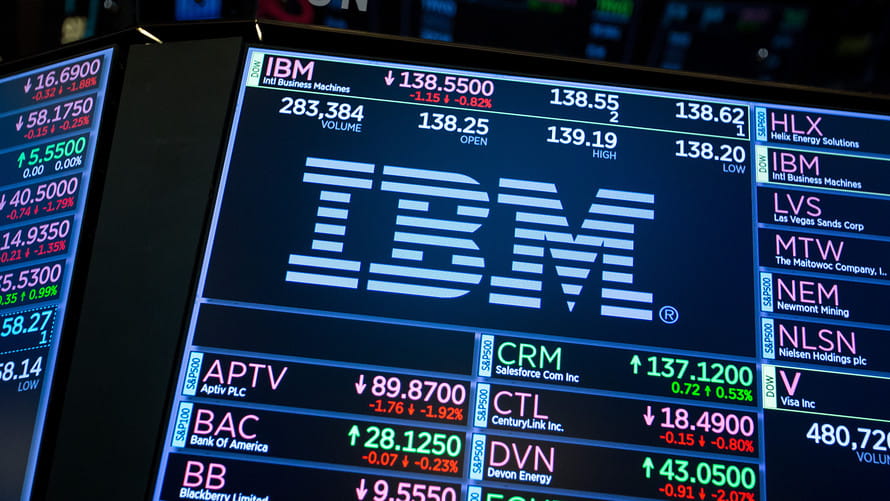
The stock price of IBM (NYSE: IBM) rose 12.48 percent to $252.97, which was the biggest one-day gain in more than a year. This happened after the Trump administration said it would invest about $2 billion in quantum computing across nine companies, with IBM getting about $1 billion through the CHIPS and Science Act.
IBM has promised to match that amount with its own money to help fund Anderon in Albany, New York. It is being called America's first dedicated quantum chip manufacturing center.
As the market started to change its view of quantum computing from long-term research and development to key national infrastructure, other stocks that are related to quantum computing also got stronger.
What the Policy Shift Actually Means
In this announcement, the U.S. government takes a very different method than it did with previous quantum subsidies. The Department of Commerce is not only giving funds to the nine companies that are receiving them; it is also buying small pieces of D-Wave, Rigetti, Infleqtion, PsiQuantum, Atom Computing, Diraq, and Quantinuum. This difference changes the nature of the commitment: Washington isn't paying for study that might never be used in the real world. It has a financial stake in the growth of the industry.
The policy goal is also very clear: to create a domestic supply chain that includes hardware systems, software environments, wafer foundry services, and the production of quantum chips. Along with national cryptographic infrastructure and semiconductor supply chain security, quantum computing is being added to the strategy framework.
There are three direct effects this has on the capital markets. Government support extends the R&D runways for businesses that need to wait a long time to go commercial and have a lot of money to spend. Having direct equity stakes in an industry raises its value by making it seem like vital infrastructure. And the fact that funding is selective speeds up divergence because the nine recipients get equipment, talent, and customer relationships that rivals who don't have funding can't easily close.
Why IBM Is the Standout Beneficiary
The market is changing the price of IBM's industrial standing, not just its R&D pipeline, which makes its 12.5% move out of line with the sector. With the $1 billion CHIPS Act grant and the $1 billion match from IBM for Anderon, IBM's quantum roadmap goes from being a research project to a national manufacturing base, which is a very different way to value it.
IBM is not a blockchain-only business. It's where quantum, enterprise software, hybrid cloud, mainframes, and AI all meet, which means that quantum powers can be added in many ways as they get better. The Z mainframe franchise grew 51% year-over-year in Q1, which shows that businesses are once again interested in high-performance computing, which quantum will finally make even better.
The basics of IBM's Q1 2026 report gave us more confidence: non-GAAP EPS of $1.91 compared to the $1.81 consensus, and sales up 9% year-over-year to $15.92 billion. The software business, especially Red Hat, kept growing, which kept cash flow stable enough to allow for longer quantum R&D cycles without putting pressure on commercial income.
IBM also raised its quarterly dividend to $1.69, making it 31 years in a row that the dividend has been raised. This kind of commitment needs clear visibility into free cash flow, which is something that pure quantum startups can't provide.
The Fault-Tolerant Quantum Roadmap That Investors Are Pricing
IBM's case for investing in quantum computing depends on a certain scientific milestone: Starling, the company's first fault-tolerant quantum computer, is set to come out in 2029 and will have 200 logical qubits and 100 million quantum gates. As of now, the only thing that separates demonstration-stage quantum from widely deployable quantum is fault-tolerant quantum computing, which means that errors can be fixed so that computations can be trusted.
If Starling does what it's supposed to do and proves usefulness in chemical simulation, financial modelling, optimisation, or cryptographic security, IBM's quantum business will move from research services to high-value workplace computing contracts. The government's promise to fund Anderon effectively gives independent confirmation that this roadmap is not only scientifically interesting but also useful for business.
IBM wants to make big quantum computers that can work even if something goes wrong by around 2030. That date lines up with when the industry has to show that the infrastructure investments that are currently being made are paying off.
Technical Levels and the Path to $400
From a price structure standpoint, IBM closed at $252.97 — above the 52-week low of $212.34 but meaningfully below the all-time high of $324.90. The next level of resistance to keep an eye on is $256.80.
If this level is broken for a long time, the price could go up to the previous all-time high. A break above $342.90 would put the $400 psychological milestone in the conversation — a level that implies full repricing of IBM as a quantum infrastructure provider rather than a legacy IT company.
The Risks That Don't Disappear With Government Money
Support for policies and ready for commercialisation are two different things. There are still real technical problems with quantum computing, such as quantum error correction at scale, hardware stability, manufacturing yields for quantum chips, and validating real-world applications across fields.
While government funding speeds up the building of infrastructure, it can't cut down on the physics-level validation cycles that are needed to find out if 200 logical qubits in 2029 will provide the promised computational edge.
Also, competition is getting tougher. There are good quantum programs at Google, Microsoft, Amazon, Quantinuum, PsiQuantum, and IonQ. The government's equity stake approach adds aspects of regulation and management that private R&D programs don't have. And once the initial policy excitement wears off, the market may once again turn its attention to bringing in money.
IBM is now being priced at $252.97 as a quantum infrastructure company with government-backed manufacturing capacity, not just as a business that works in enterprise IT and does quantum research.
This week's news of Anderon's strategic designation, IBM's existing business relationships, and a fault-tolerant roadmap aimed at 2029 create a multi-year investment thesis that didn't exist before.
The first technical test to see if the market's repricing is real or if it overshoots on the first news is at $256.80, which is the short-term support. In the long run, it will depend on Starling and whether 2029 fault-tolerant quantum delivers commercial value at the scale that the current valuation suggests.


Bonus rebate to help investors grow in the trading world!