English




Nvidia Soars on China H200 Approval — Is a $50B Market Finally Opening?

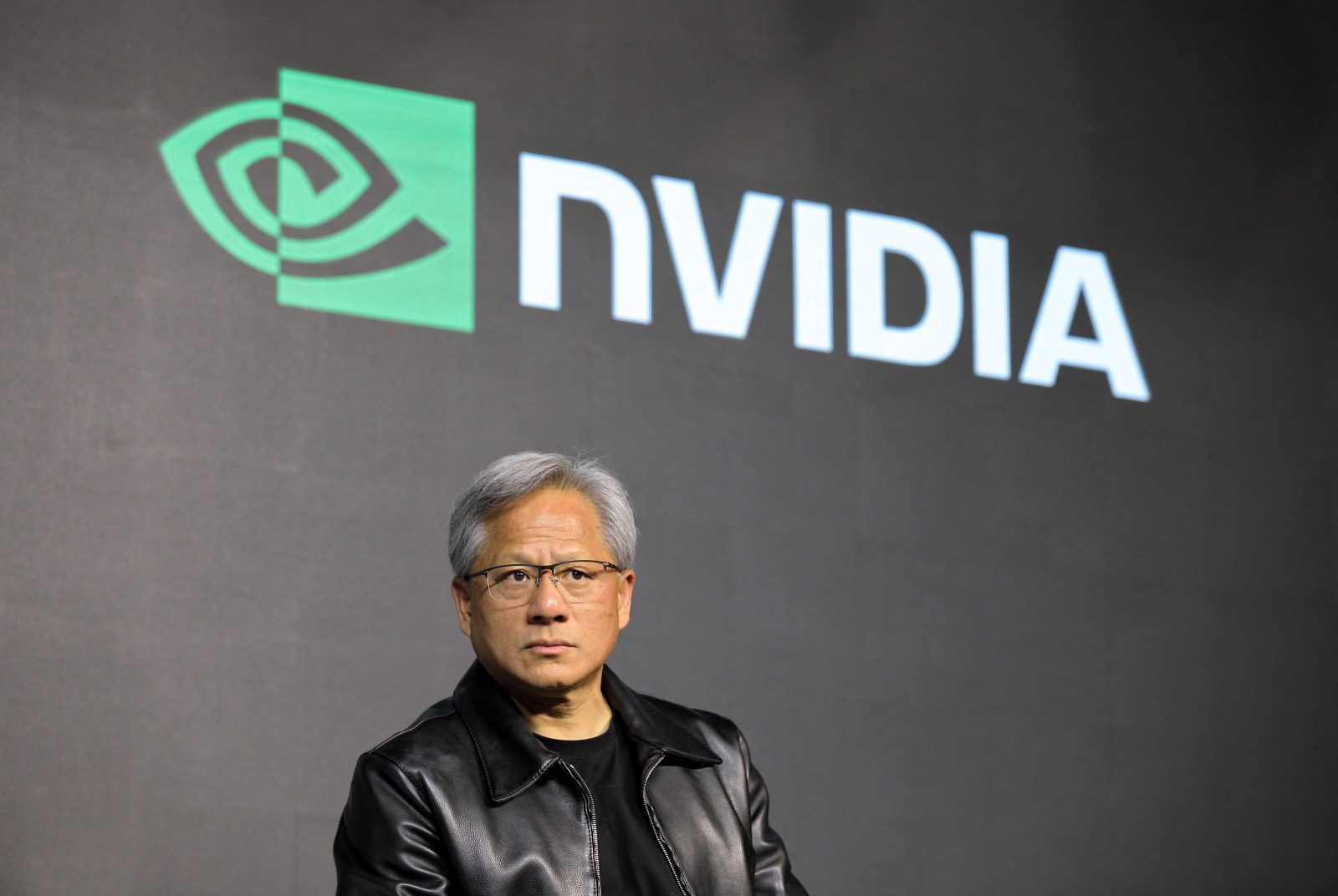
Nvidia (NVDA) shares climbed in premarket trading Thursday after Reuters reported that the U.S. has approved approximately 10 Chinese companies — including Alibaba, Tencent, ByteDance, and JD.com — to purchase its H200 AI chips. The stock had already been pushing toward record highs before the news landed, and the China approval story added another layer of fuel to a rally that has made Nvidia one of the defining trades of 2025.
The timing wasn't coincidental. CEO Jensen Huang joined President Trump's delegation to Beijing — reportedly picked up by Trump in Alaska en route to the Xi Jinping summit — in what reads less like a diplomatic courtesy and more like a direct effort to unblock a commercial relationship that tighter U.S. export controls had effectively frozen.
Before those restrictions tightened, Nvidia controlled roughly 95% of China's advanced AI chip market. China had previously represented around 13% of Nvidia's total revenue. Recovering even a fraction of that ground matters enormously at the revenue scale Nvidia is now operating.
Huang's own estimate: China's AI chip market could be worth $50 billion to Nvidia this year alone.
What the Approval Actually Covers — and What It Doesn't
The specifics of the Commerce Department authorization are worth understanding precisely, because the gap between "approval granted" and "revenue recognized" is wider than the initial headlines suggested.
Each of the roughly 10 approved buyers — which also include distributors Lenovo and Foxconn alongside the major tech platforms — is authorized to acquire up to 75,000 H200 chips either directly from Nvidia or through approved intermediaries. Lenovo confirmed its inclusion publicly, stating it is "one of several companies approved to sell H200 in China as part of Nvidia's export license."
Here's where it gets complicated: no transactions have been finalized. Chinese companies, Reuters reported, became notably more cautious following guidance from Beijing, and pressure within the Chinese government to either block or closely review potential purchases has reportedly intensified.
The exact trigger for that shift in sentiment remains unclear, but the pattern is familiar — approvals on the U.S. side running into political headwinds on the Chinese side, with commercial buyers caught in the middle watching for signals from both governments before committing.
That dynamic explains why Huang's presence in Beijing matters beyond symbolism. Restarting $50 billion in potential chip sales requires more than export licenses — it requires a political environment in China where buyers feel comfortable completing transactions without worrying about domestic backlash. The summit with Xi creates at least the possibility of that environment.
KeyBanc analyst John Vinh translated the authorization numbers into revenue terms: 1.5 million H200 chips sold to China at current pricing translates to roughly $30 billion in potential revenue, with approximately 25% of proceeds potentially directed to the U.S. government under ongoing negotiations. Whether that math materializes depends entirely on whether the geopolitical logjam clears — which is precisely what this week's Beijing meetings are designed to address.
Wall Street Has Been Raising Targets Ahead of the May 20 Earnings Report
The China approval news arrived against a backdrop where analysts had already been upgrading their Nvidia outlooks. Several major firms moved price targets higher in recent weeks ahead of the May 20 earnings report:
Cantor Fitzgerald raised its target to $350. Bank of America moved to $320. UBS lifted to $275. Melius Research sits at the top of the range with a $380 target. The Street average has settled around $270, implying roughly 20% upside from recent trading levels — though some analysts see a path to $300–$390 if Nvidia regains the historical valuation premium it held over peers before the export restriction overhang weighed on sentiment.
The May 20 report is what the market is genuinely building toward. The Zacks consensus sits at $1.77 EPS and $78.75 billion in revenue — numbers that would themselves represent substantial growth, but which could look conservative if China sales begin flowing through and hyperscaler demand continues at its current pace.
The scenario traders are mapping: a beat-and-raise that validates both the AI infrastructure demand story and the China market reopening thesis could push the stock toward the $350–$380 range that aggressive analysts are targeting. A miss, particularly if accompanied by any softness in guidance, would trigger volatility — though with AI chip supply reportedly sold out for the fiscal year, the demand picture is hard to argue against regardless of what any single quarter shows.
The Business Running Underneath All the Geopolitics
Strip away the China diplomacy and the earnings anticipation, and what remains is a company that has built a near-monopoly on the hardware layer of the global AI buildout — and shows no sign of losing it.
Amazon, Alphabet, and Microsoft all run their AI infrastructure on Nvidia GPUs despite having active in-house chip development programs. The pattern repeats across hyperscalers: internal chip projects exist, custom silicon is deployed in specific workloads, but when it comes to frontier AI training and inference at scale, Nvidia's architecture remains the default.
That stickiness isn't accidental — it reflects years of software investment in CUDA, Nvidia's programming framework, which has created switching costs that hardware specs alone don't capture.
Huang has projected $1 trillion in AI chip sales across 2026 and 2027 combined — a number that sounds audacious until you map it against the capex commitments already announced. Hyperscalers have collectively committed over half a trillion dollars in AI infrastructure spending, and that figure continues to grow quarter after quarter.
Nvidia is the primary beneficiary of that spending, and the Nemotron 3 Nano Omni launch, partnerships with ServiceNow, and deals with Corning to support fiber infrastructure for data centers all suggest the company is working to extend its position across the AI stack rather than just supply GPUs and wait.
The recent expansion into software and services matters for a structural reason: it moves Nvidia toward recurring revenue streams that don't depend on quarter-to-quarter chip shipment volumes.
A company generating software subscription revenue alongside hardware sales carries a different valuation profile than a pure semiconductor manufacturer — and that distinction is part of what justifies price targets well above where conventional chip sector multiples would land.
China: The Largest Variable and the Least Predictable
The $50 billion China opportunity is real. The path to capturing it is not straightforward.
Before export restrictions tightened, Nvidia's position in China's AI chip market was extraordinary — 95% share is not a competitive moat, it's a monopoly.
Rebuilding from near-zero back toward any meaningful fraction of that position depends on factors outside Nvidia's direct control: U.S. export policy, Chinese government purchasing guidance, and the broader state of US-China relations across trade, technology, and security dimensions.
The Trump-Xi summit this week addresses all of those dimensions simultaneously, which is why Huang's presence in the delegation matters as much as the specific chip approvals. A summit that produces meaningful progress on trade and technology cooperation creates the political cover Chinese buyers need to complete transactions.
A summit that generates friction — or one where technology export controls become a bargaining chip in a broader negotiation — could push the timeline further out regardless of what the Commerce Department has already authorized.
The approved buyers themselves are the right set of companies to anchor the initial wave of sales. Alibaba, Tencent, and ByteDance are operating at the frontier of Chinese AI development and have genuine technical need for H200-class hardware.
ByteDance in particular — the parent of TikTok — has been building AI infrastructure at scale and represents exactly the kind of customer that converts approved licenses into actual chip orders quickly once the political environment permits.
The 75,000-chip-per-buyer cap creates a ceiling on initial sales but doesn't limit what comes next if the approval framework expands. At current pricing, 750,000 chips across 10 buyers approaches $15–20 billion in revenue before any additional authorizations. The math gets considerably larger if caps loosen or the approved buyer list grows.
What May 20 Needs to Show
The earnings report in less than two weeks arrives with the China story still in motion. Huang and the delegation are in Beijing now; whether that produces anything commercially concrete before May 20 is unlikely — supply chains and purchase agreements don't move at diplomatic speed. What the market will focus on instead:
Revenue guidance for the next quarter relative to the $78.75 billion consensus. Any upward revision — particularly if Nvidia begins accounting for China pipeline even in preliminary terms — would be the catalyst for the next leg higher.
Gross margin trajectory. H200 chips carry strong margins, and China revenue would add to that picture. But manufacturing costs, logistics, and the government revenue-sharing arrangement under negotiation could compress margins relative to domestic sales — the Street will want clarity on the profitability structure of China shipments.
Supply constraints and allocation. If AI chip supply is indeed sold out for the fiscal year, the May 20 call will be where Huang discusses how China demand gets prioritized against hyperscaler commitments. That allocation conversation has direct implications for both revenue timing and customer relationships.
A clean beat with raised guidance would validate the record-high stock price and support the bull case toward $350–$380. The risk isn't that the business is deteriorating — it clearly isn't. The risk is that the stock has already priced a version of the China reopening and the AI supercycle that leaves little room for execution friction or timeline slippage.
The Bottom Line
Nvidia sits at the intersection of the two biggest investment themes in global markets right now: the AI infrastructure buildout and the US-China technology relationship. Both are in motion simultaneously this week, with Huang in Beijing and earnings three weeks away.
The H200 approvals are meaningful — they represent a genuine policy shift toward re-engaging China's AI market after a period of escalating restrictions. The absence of completed transactions is equally meaningful — approvals and revenues are different things, and the Chinese government's cautious posture toward approved buyers is a real constraint on how quickly that $50 billion opportunity converts into recognized revenue.
For investors, the setup heading into May 20 is straightforward in its outlines and complicated in its execution: extraordinary business fundamentals, a massive addressable market that is partially reopening, a summit this week that could accelerate or complicate the timeline, and a valuation that already reflects a lot of good news. The next meaningful data point arrives on earnings day.
Until then, the market is choosing to price the bull case — and the China approval story gave it one more reason to do exactly that.


Bonus rebate to help investors grow in the trading world!