English




Oil Surges Past $115 as Houthis Join Iran War and Hormuz Stays Shut

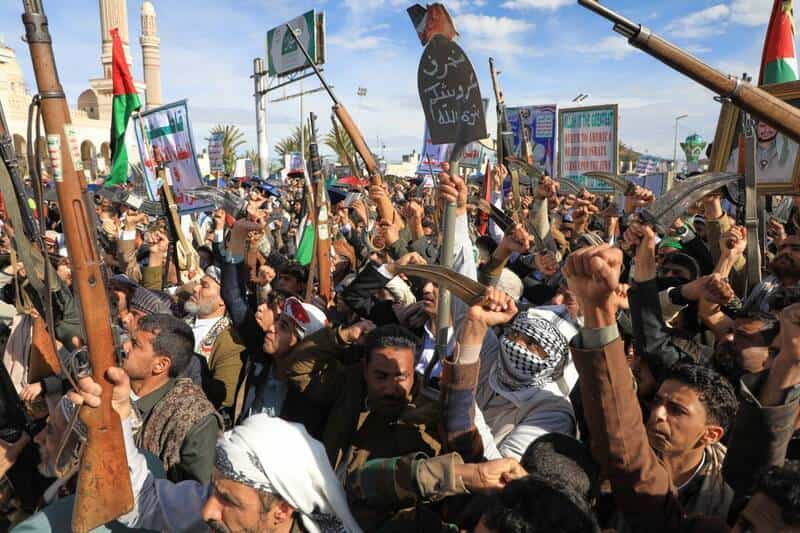
Monday, the price of Brent crude rose 2.7% to $115.55 a barrel, briefly touching $116.43 at the session high. This happened as the U.S.-Israeli war on Iran began its second month and grew in many ways at the same time. WTI went up 1.8% to $101.41. Brent has gone up almost 60% since the war started in late February, and the supply shock that caused those gains is not going away; it's getting worse.
Over the weekend, three events changed the risk equation: the Houthi rebels in Yemen fired their first missiles at Israel; the U.S. sent an extra 3,500 troops to the area on the USS Tripoli; and President Trump told the Financial Times that he was willing to take over Kharg Island and Iranian oil. If Trump followed through on this threat, there would be no way to quickly calm down the situation.
The Houthi Entry Changes the Threat Map
The Strait of Hormuz was the main problem for the energy market until Sunday. Since the war started, it has been closed, cutting off about 20% of the world's oil and LNG supply. The Houthis' involvement in the war adds a second risk of a chokepoint. In 2024, the group showed that it could attack ships going through the Bab al-Mandab Strait, which is a small waterway that connects the Indian Ocean to the Gulf of Aden.
"The Houthis' weekend involvement and the arrival of additional U.S. troops underscore the conflict's widening scope," OCBC analysts said Monday. Vital Knowledge analysts went even further, saying that the Houthis' attack on Bab al-Mandab would "dramatically amplify" the world shipping problem that Hormuz's shutdown had already caused. Two chokepoint failures happening at the same time would cause a supply shock that has never happened before in modern times.
OCBC kept its base price for Brent at around $100/bbl until the middle of the year, after which it started to slowly lower it in the second half of 2026. However, it made it clear that this base price expects no further price increases, which seems more and more unlikely.
Trump's Iran Signals: Negotiation and Escalation at the Same Time
Trump's upbeat remarks about negotiations were given little weight by markets on Monday, and for good reason. Speaking on Air Force One, Trump stated that negotiations were doing "extremely well" and that "a deal with Iran could be soon," characterizing Iran's new leadership as "very reasonable." Over the weekend, Iran permitted 20 oil tankers flying the Pakistani flag to cross the Strait, which Trump described as a surrender to the United States.
On the same weekend, comments came out that went the other way. The Wall Street Journal said that Washington is thinking about using armed force to get almost 1,000 pounds of uranium from Iran. This would be very difficult to plan and would be very controversial publicly. Reports say that the Pentagon is getting ready for weeks of operations on the ground in Iran. The 31st Marine Expeditionary Unit is already there. Tehran promised to destroy any U.S. troops that tried to invade from the ground and said that Washington was planning just that behind the scenes.
Iranian assaults on a Saudi air base over the weekend resulted in at least 12 injuries to American soldiers. The markets no longer view Trump's fourth extension of the Strait of Hormuz deadline, which was extended to April 6, as a legitimate de-escalation signal.
"Markets remain very much on edge about the Middle East, and the consensus view is still that the conflict is set to escalate," Vital Knowledge analysts told clients.
Macro Overhang: NFP Friday and the Fed's Impossible Position
Beyond geopolitics, two U.S. data releases this week will assess the extent to which the economic harm caused by the Iran War has affected the home economy. Wednesday's ISM manufacturing report is anticipated to demonstrate ongoing growth, albeit more slowly. The most important event is Friday's nonfarm payrolls; experts predict 56,000 new jobs in March, a small recovery from February's 92,000 fall.
The Fed's predicament is becoming worse. Rate-hike expectations are rising due to energy-driven inflation; a declining labor market would support cuts. "The market should be prepared for Fed tightening this year in reaction to the energy shock after Friday's NFP announcement, according to ING strategists. "Any surprise weakness could hit the dollar."
Significant cross-asset ramifications result from any scenario, and oil's position over $110 guarantees that the inflation side of the equation will continue to dominate until the Hormuz problem is resolved.
Now that Brent is above $115 and there is a second supply bottleneck, Goldman's bad scenario of prices going above the record set in 2008 is not just a tail risk; it's a situation with a clear path. The April 6 Hormuz deadline, the NFP print, and any political movement between Washington and Tehran that can be checked will determine the direction of crude oil until the middle of the month. The structural bid in energy stays the same until at least one goes in a positive direction.


Bonus rebate to help investors grow in the trading world!