English




Samsung Strike Begins as 47,000 Workers Walk Out After Talks Collapse

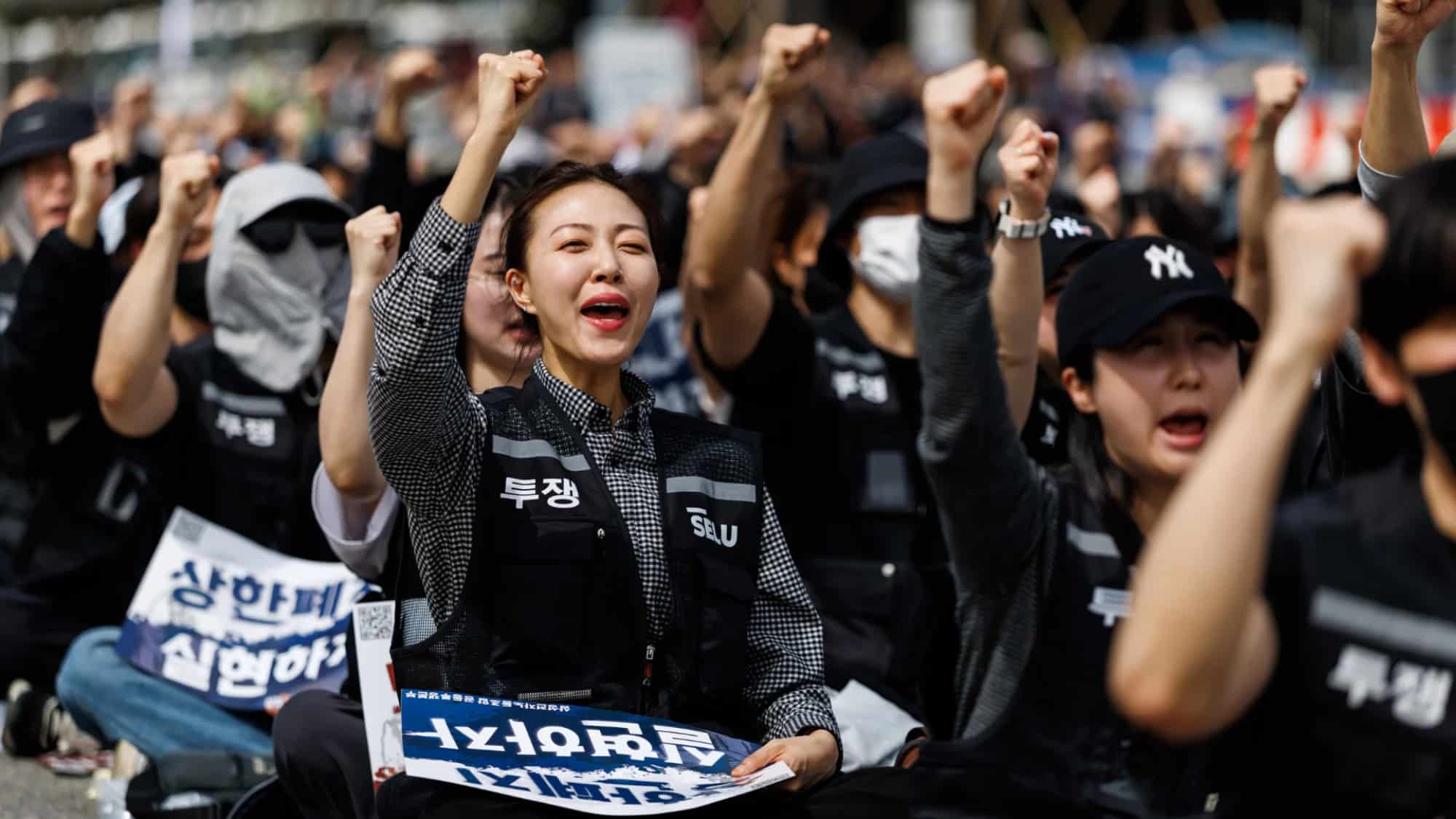
Shares of Samsung Electronics fell 3% on Wednesday after the company's labor union announced a general strike starting Thursday. The strike will involve more than 47,000 workers, making it the biggest in the company's history. The announcement came after last-minute talks mediated by the government failed to reach a settlement. The walkout happens at the worst possible time for the world's chip markets. Demand for AI infrastructure is at an all-time high, and memory supplies are already very tight.
Why Talks Broke Down
The immediate reason for the breakdown was a problem with the way things were being done, but the real problem is a disagreement over who should gain from Samsung's record profits.
Choi Seung-ho, a spokesperson for the union, said that the union had agreed to the National Labor Relations Commission of South Korea's mediation offer. However, Samsung's management "delayed its decision and failed to state its position," which meant that the mediation process was over. Choi said, "We deeply regret that the post-mediation process had to end because management was taking too long to make a decision." He also said that the union would still be trying to reach a deal even though the strike was going on.
Samsung didn't agree with this wording. The company said that talks broke down because the union kept asking for "socially unacceptable levels of compensation even for loss-making business units." This was a direct reference to the union's insistence that all divisions should get the same bonus structure, no matter how profitable they were. "Samsung said, "This directly goes against the company's basic principle that pay should follow performance."
The main cash demands make the impasse impossible to break. The union wants performance bonuses equal to 15% of Samsung's operating profit, the end of caps on bonus payouts for good, and a more formalized bonus system. Samsung has always capped bonuses at 50% of a worker's salary. This means that the huge gains the company is making from the AI memory boom are not being put toward paying workers as much as they think they should.
According to Kamil Dimmich, partner and portfolio manager at North of South Capital, the money at stake is very high: "These are huge numbers; they could potentially mean millions of dollars in payouts for many employees at Samsung." The main point of contention is getting rid of the bonus cap for good.
This would make Samsung less profitable forever, even during economic downturns. Dimmich said, "We need to think about what comes after this boom." "This boom will fade away soon." Supply and demand will level off at some point, and the price of memory will go down.
To give you an idea, the workers at SK Hynix agreed to a bonus plan that gave them 10% of their running profit. The Samsung union wants 15% to 50% more than what the competition is offering.
The Supply Chain Stakes
At this point, a Samsung walkout would have supply effects that go far beyond the company's own activities. Samsung makes more memory chips than any other company in the world. It is one of the three companies that make most DRAM and HBM. It's also the only part of Samsung Electronics where a big problem with output would have a direct effect on building out the AI infrastructure.
Both SK Hynix and Micron have booked all of their 2026 HBM capacity. Neither can really take in a lot of Samsung production if the strike keeps stopping work for a long time. Spot prices for conventional DRAM and NAND could go up within weeks of a prolonged production halt. These prices are already high because of the AI demand cycle.
The timing is perfect because this is the busiest time of year to buy AI servers. Amazon, Google, Microsoft, and Meta are some of the biggest hyperscalers. They have total capital expenditures budgets of about $700 billion for 2026, and memory chips are one of the most important things they need to buy. Not having enough supplies from Samsung doesn't affect a market that is already fair; it affects a market that is already short on supplies.
A South Korean court had already said that the strike couldn't affect safety facilities or get in the way of work. This limited, but didn't completely eliminate, the damage that could be done to production. Because of the law, this is not an immediate stop in output. Instead, it is a long-term walkout that raises the rate of mistakes, slows down maintenance cycles, and over time puts pressure on yield.
The Government's Emergency Option
South Korean officials have been putting a lot of pressure on both groups. In the days before the strike, both President Lee Jae Myung and Prime Minister Kim Min-seok called for an end to the standoff. South Korean law says that if a disagreement is likely to hurt the national economy, the labor minister can call for a "emergency adjustment" to stop work stoppages for 30 days.
The main short-term circuit breaker is the government's clear intention to use that method. An emergency adjustment invocation would stop the strike, start negotiations again under required mediation, and get rid of the immediate risk of supply disruption. However, it would not solve the underlying wage structure dispute, which will come up again when the suspension ends.
Samsung said, "We will not give up on dialogue until the very end" and "We will continue to try to settle the dispute through more mediation or direct talks." This language means that a settlement can still be reached through talks, even though workers are leaving.
The 3% drop in Samsung's stock price due to the news of the strike is small compared to the supply risks if the walkout lasts a long time. The memory market already has a supply deficit that has never been seen before. Micron's full 2026 HBM output is sold out, SK Hynix reported record margins and a sold-out order book, and spot DRAM prices have been steadily rising.
If Samsung's production is interrupted for a long time, prices will probably go up across the board, and Samsung's own output and profit margins will also go down. Watch for South Korean government emergency adjustment invocation as the most likely near-term resolution mechanism — and watch Samsung's weekly chip output data for any early signs of yield or production rate impact from the strike's first days.


Bonus rebate to help investors grow in the trading world!