English




Strategy Sells Bitcoin First Time in 4 Years: Why It Matters

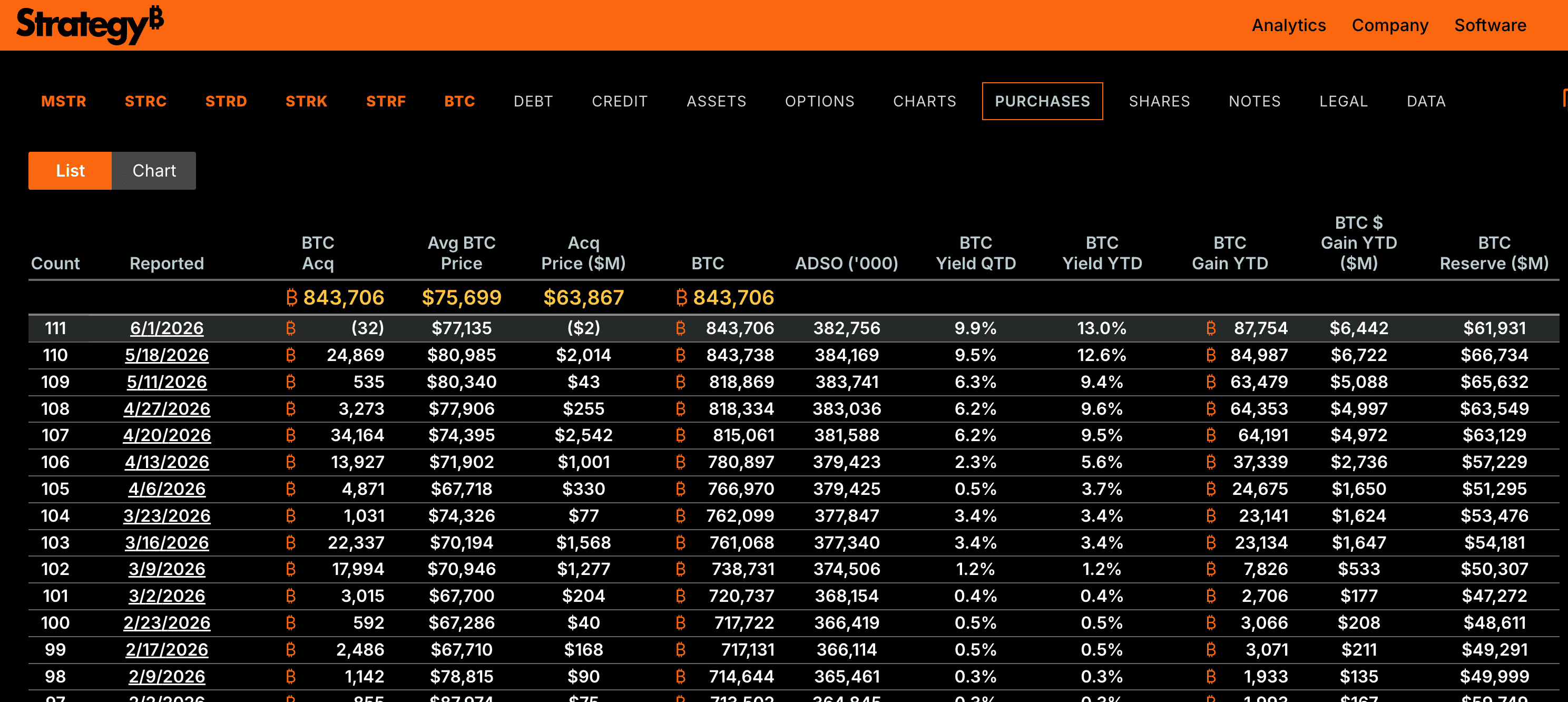
As of June 2, 2026, a June 1 8-K filing rattled markets: Strategy (formerly MicroStrategy) sold 32 bitcoin between May 26 and May 31 at a net average of $77,135, raising about $2.5 million — its first net disposal after 41 straight months of accumulation. MSTR fell roughly 5-6% on the day, while Bitcoin slipped below $72,000 to a near two-month low around $71,000. The puzzle: 32 BTC is less than four-thousandths of a percent of the company's 843,706-coin treasury. So why did markets react so sharply?
The Sum Is Trivial; The Story Collapsing Is Not
Start with the math. Thirty-two coins against 843,706 is about 0.0038% of holdings. Two Wall Street analysts flatly called the trade "economically immaterial," reading it as a tactical move to fund a preferred dividend rather than a policy reversal. On the balance sheet, they're right.
But markets don't only price balance sheets — they price narratives. For years, Executive Chairman Michael Saylor publicly insisted he would "never sell" and championed "diamond hands." That slogan was the emotional scaffolding behind MSTR's premium valuation and the faith anchor for the entire "Bitcoin treasury company" category. When crypto's most prominent corporate evangelist hit the sell button for the first time, what cracked wasn't the ledger — it was the premise that "he will never sell." Once that premise wobbles, the market re-prices a new reality: that Saylor will sell under pressure. That re-pricing is the real reason behind the 6% drop.
Why Forced to Sell? The Flywheel's "Dividend Gap" Surfaces
To grasp the deeper meaning, unpack MSTR's business model. It's essentially a leveraged flywheel: issue common stock (ATM), convertible debt, and a suite of perpetual preferreds (STRK, STRF, STRD, STRC), use the proceeds to buy Bitcoin; rising BTC lifts the stock premium, which makes raising more capital easier, which buys more BTC. The catch: those preferreds require cash dividends, and Bitcoin itself produces no cash flow.
In a bull market, fresh equity and debt issuance cover the dividends. But when prices sag, ETF capital flows out, and refinancing windows narrow — where does the cash come from? Now we have the answer: sell Bitcoin. Saylor essentially pre-announced this on an earnings call, saying the company would "probably sell some bitcoin to pay a dividend just to inoculate the market and send the message that we did it." So this wasn't an accident — it's proof that, absent new financing, the flywheel is forced to dip into principal to service its obligations. For contrarians, the thing to watch isn't these 32 coins; it's the race between future preferred-dividend obligations and the company's ability to refinance.
Will History Repeat? The 2022 "Fake Sale" vs. This One
Bulls are reaching for a historical comfort: in December 2022, near a bear-market bottom, the company sold 704 BTC around $18,000, then bought back 810 BTC two days later at a lower price — a tax-loss harvesting maneuver later read as a bottom signal. Some now cite it to suggest this sale could also mark a floor.
The analogy is shaky. The 2022 trade was an active tax arbitrage that immediately re-added to the stack — directionally still net accumulation. This one is a passive reduction to fund fixed dividends — defensive bleeding, not offensive financial engineering. More telling is the macro backdrop: with Bitcoin near $71,000, the price has fallen below MSTR's $75,699 average cost basis, meaning the entire treasury is now underwater on paper. A "never sell" company forced to sell below its cost line to pay dividends erodes confidence far more deeply than a tax-loss trade ever did.




Bonus rebate to help investors grow in the trading world!